 skval
skval
skval
skval
Give it a skill, get a score.
The Skill Validator Framework — point it at a Claude Code skill and get back a
0–100 score, a letter grade, a per-dimension breakdown, ranked findings, and a
Ship / Revise / Reject verdict. The measurement counterpart to skill-creator.
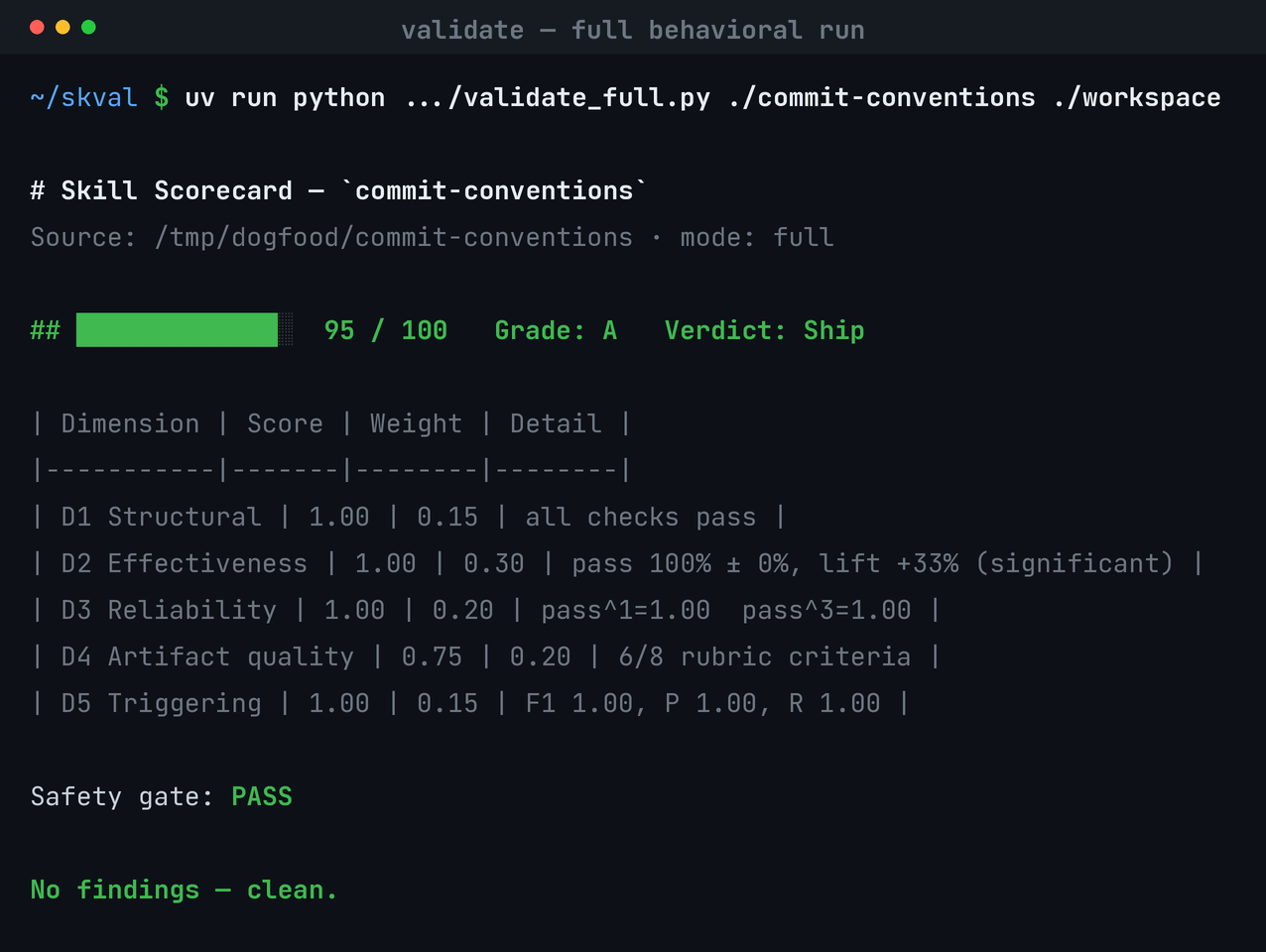
A safety-gated, normalized weighted composite over six dimensions — reported as a vector and a single number.
| Dim | Dimension | Weight | How it's measured |
|---|---|---|---|
| D1 | Structural integrity | 0.15 | deterministic |
| D2 | Effectiveness (pass rate + lift over a no-skill baseline) | 0.30 | behavioral, LLM-graded |
| D3 | Reliability (pass^k over N trials) | 0.20 | behavioral |
| D4 | Artifact quality (decomposed LLM rubric) | 0.20 | LLM-as-judge |
| D5 | Triggering (precision / recall / F1) | 0.15 | behavioral |
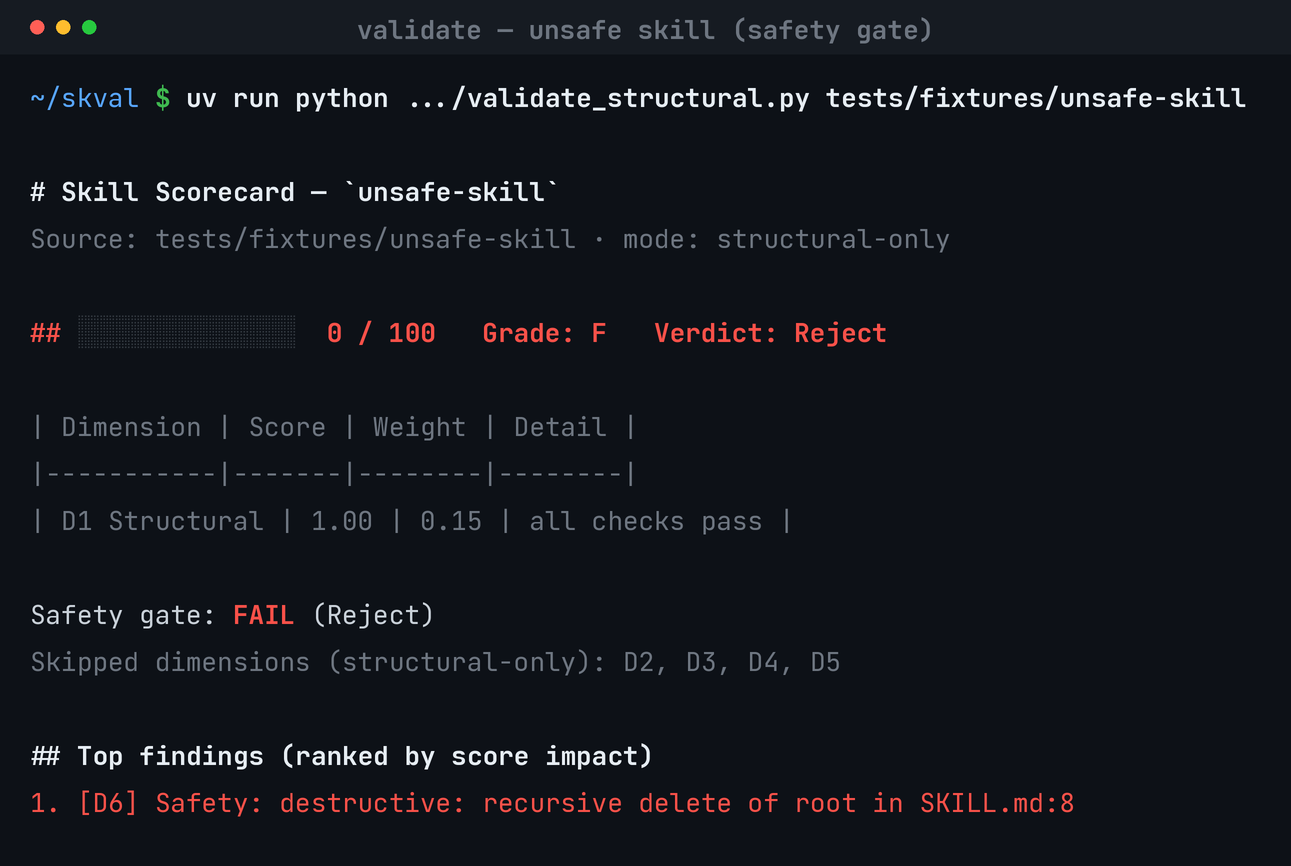
| D6 | Safety / least-surprise | gate | unsafe ⇒ score 0, verdict Reject |
Bands: A≥90, B≥80 (Ship) · C≥70, D≥50 (Revise) · else F (Reject). skval also classifies the skill (task / file-transform / interactive / discipline / reference) and routes evals accordingly.
skill-creatorThey aren't rivals — they're two halves of one loop. Anthropic's skill-creator helps you
write and iterate on a skill with a human in the loop; skval gives an automated, defensible
verdict on the result — and can audit skills you didn't write. skval even
exports to skill-creator's eval-viewer,
so the two interoperate.
| Capability | skill-creator | skval |
|---|---|---|
| Primary job | Author & iterate (draft → test → improve) | Audit & grade a finished skill |
| Headline output | Eval viewer + benchmark; you decide | 0–100 score, grade, Ship / Revise / Reject |
| Structural / lint checks | — | ✓ deterministic static checks (D1) |
| Safety gate | — | ✓ veto gate + safe extraction of untrusted skills (D6) |
| Offline, no-model path | — needs model runs + review | ✓ deterministic scan, CI-gateable (exit ≠ 0 on Reject) |
| Pre-run cost estimate | — tokens / time only, after the run | ✓ token + $ projection before you launch |
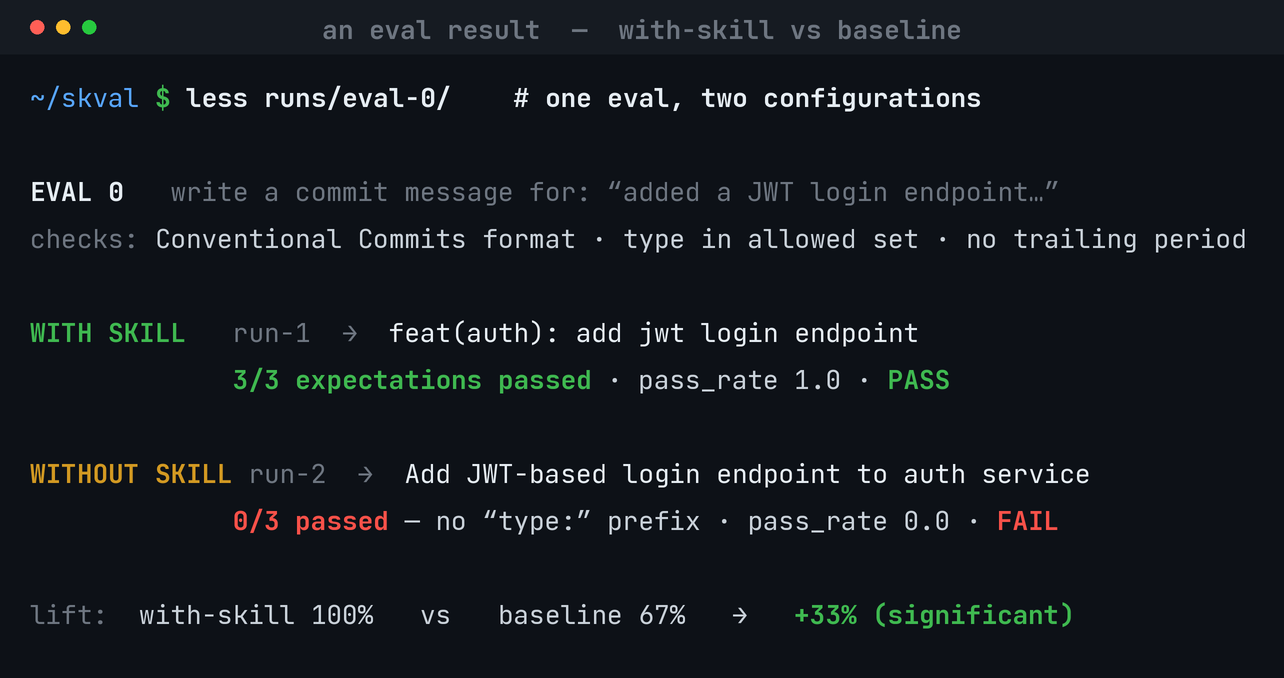
| With-skill vs. baseline evals | ✓ core of the loop | ✓ effectiveness + lift, significance (D2) |
| Reliability | variance (mean ± stddev) | ✓ pass^k over N trials, scored (D3) |
| Triggering | ✓ description optimizer (train / test) | ✓ precision / recall / F1, scored (D5) |
| Skills you didn't write | aimed at your own authoring | ✓ dir / SKILL.md / .skill, untrusted-safe |
| Many skills at once | single-skill iteration | ✓ batch leaderboard + regression history |
| Judge-bias controls | blind A/B (optional, advanced) | ✓ blind + position-swap + cross-family by default |
skill-creator when…you're building a skill — capturing intent, drafting, and iterating on a handful of examples with your eyes on every output.
you need a decision: is it good enough to ship? did my edit regress? is this third-party skill safe? — or you're gating many skills in CI.
skval's deterministic structural scan over 10 widely-used skills — 8 ship as-is; the two flagged hit the size budget. Plus runs over 75 installed skills and 123 from the web — and a five-run behavioral study (variance 0 across repeats, audited contamination finding). See the full benchmark →
| Skill | Type | Score | Findings |
|---|---|---|---|
| mcp-builder | task | 100 / A | — |
| frontend-design | task | 100 / A | — |
| test-driven-development | discipline | 100 / A | — |
| file_transform | 100 / A | — | |
| pptx | file_transform | 100 / A | — |
| canvas-design | file_transform | 100 / A | — |
| xlsx | file_transform | 100 / A | — |
| web-artifacts-builder | task | 100 / A | — |
| skill-creator | file_transform | 96 / A | SKILL.md ~8246 tokens (>5000) |
| docx | file_transform | 92 / A | 599 lines & ~5142 tokens (over budget) |
skval doesn't just grade — its ranked findings drive the fix. Real published skills, scored verbatim then fixed and re-scored to a clean 100 — turnarounds up to +62, Reject → Ship:
A real published skill (glebis/claude-skills) shipped with no YAML frontmatter — no name, no description, so it can't trigger. Add the frontmatter block: compare.py +62, Reject → Ship. case study →
An unquoted colon broke its YAML — it used to crash skval, and now scores. One-line fix: quote the description. compare.py +50, Revise → Ship. case study →
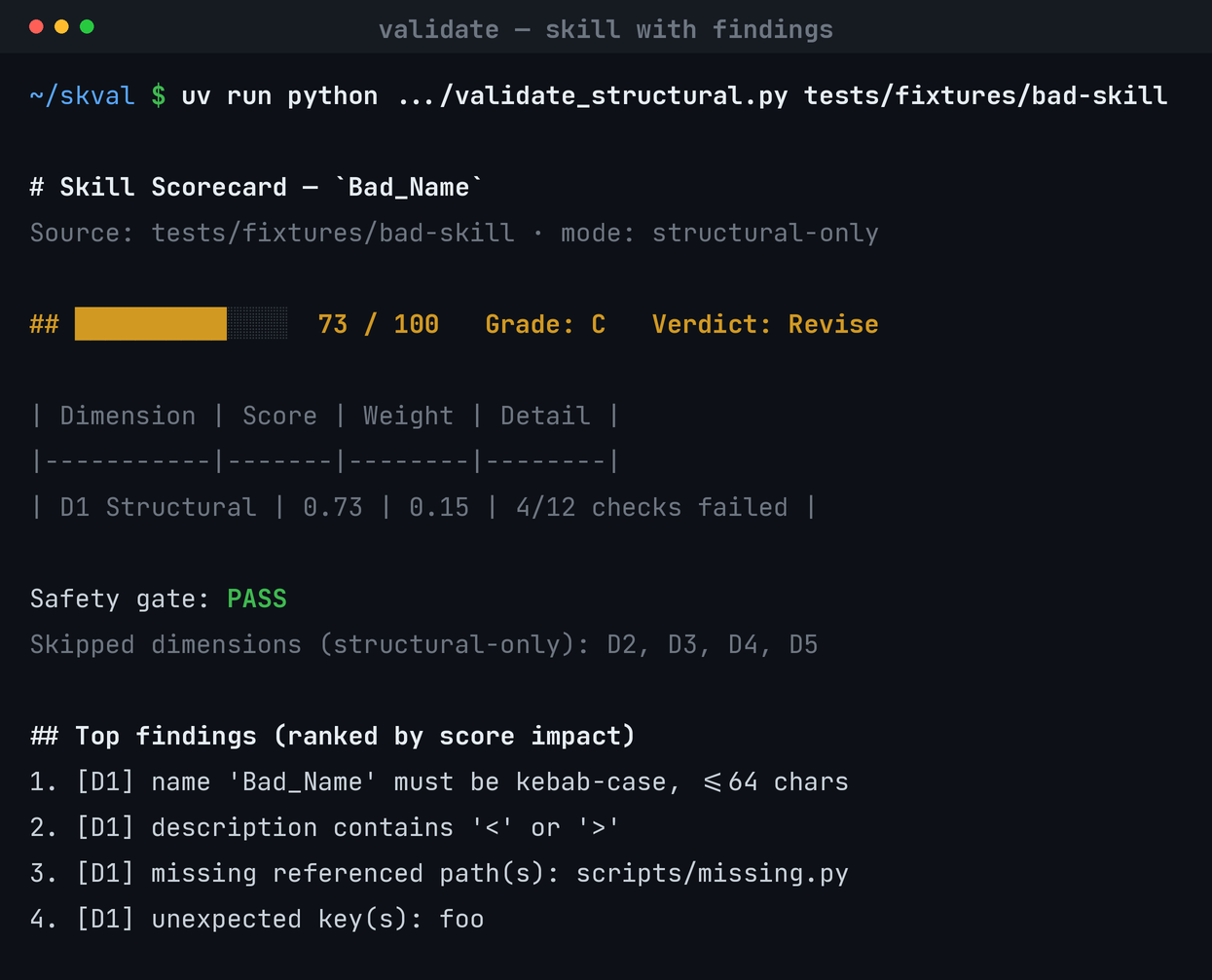
Four findings fixed one-for-one — kebab name, drop <>, broken ref, stray key. compare.py +27, Revise → Ship. case study →
<> in description · 92 → 100Angle brackets in the description break parsers and triggering — drop them to score clean. compare.py +8. case study →
A full validation spawns dozens of subagents (~1M tokens for a default run). For token-billed / enterprise
teams, skval estimate projects the token + $ cost up front — deterministic, no model calls.
# preview the cost of a full run (directory, SKILL.md, or .skill archive)
uv run skval estimate <skill-source>

# → ## $4.04 – $6.19 – $12.23   (684k – 1.04M – 2.04M tokens)
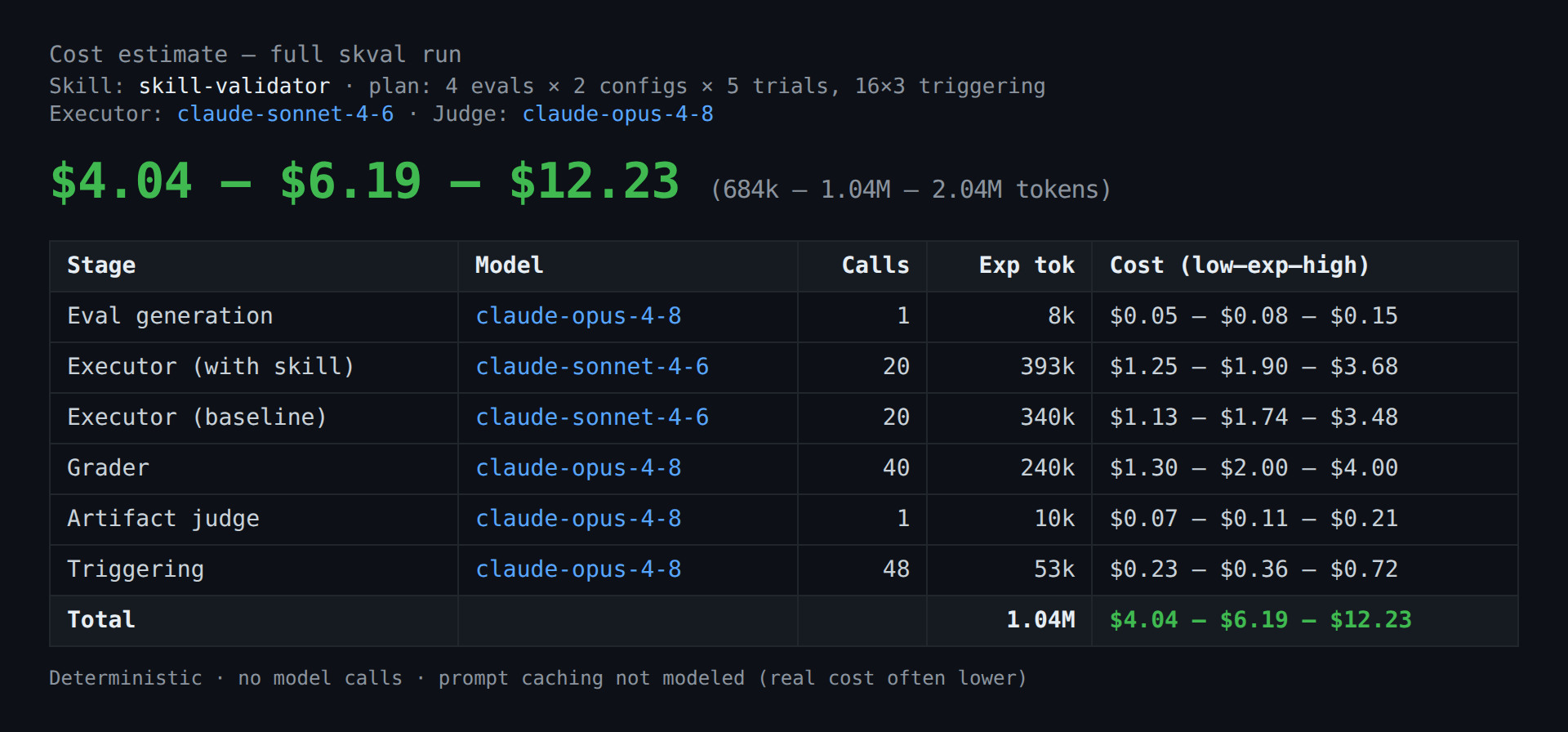
skval estimate — a low / expected / high range, broken down per stage.Per-stage token assumptions (executors, graders, judge, triggering) × your run plan × a per-model rate table, as a low / expected / high range. Anchored to observed runs; prompt caching isn't modeled, so real cost usually runs lower.
Flags for --evals, --trials, --configs, and the --executor-model / --judge-model. Read-only by default; --write also saves an estimate.json.
Run the deterministic scan now — no model calls, fully offline:
# install
uv venv && uv pip install -e ".[dev]"

# score a skill (directory, SKILL.md, or .skill archive)
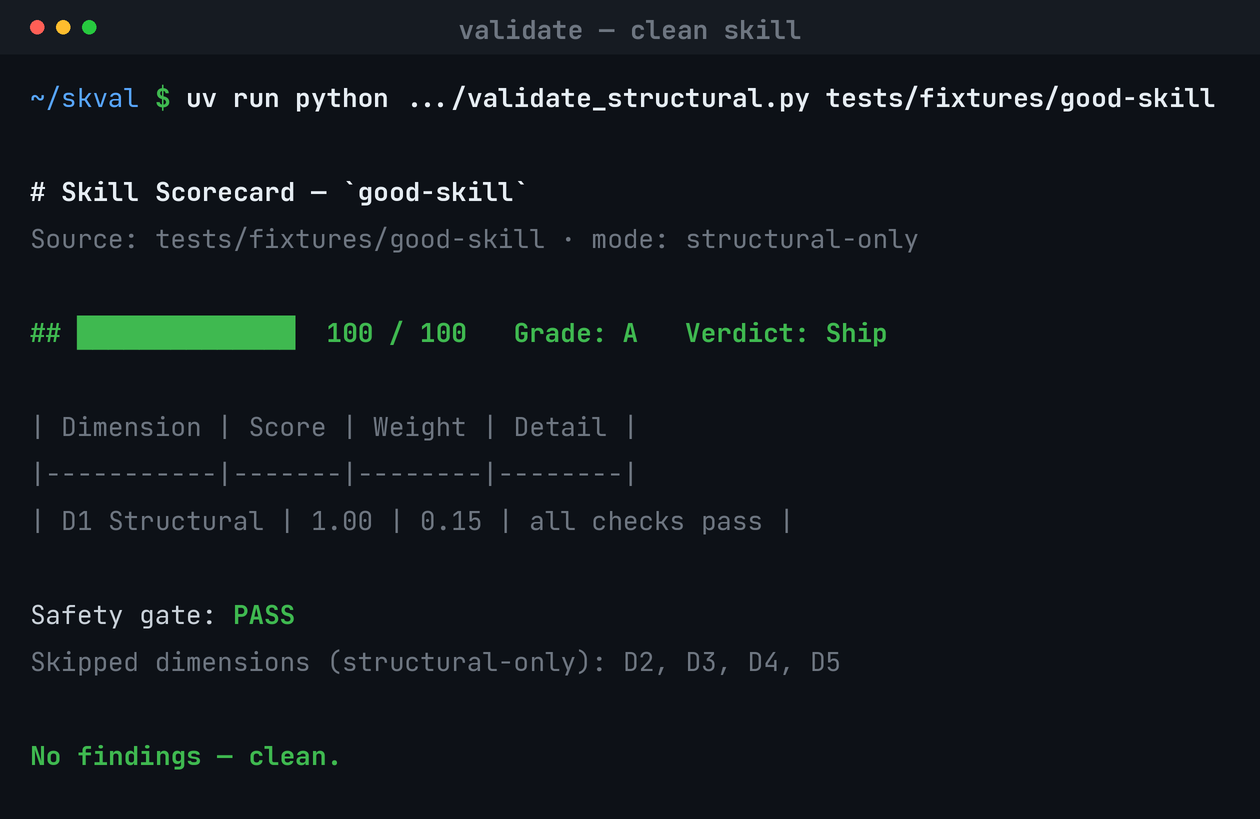
uv run skval structural <skill-source>

# → ██████████████  100 / 100   Grade: A   Verdict: Ship
For the full six-dimension run, ask Claude to “validate / score this skill” — it generates evals, runs the task with and without the skill, grades the outputs, judges quality, and tests triggering, then assembles the scorecard (preview the cost first).
docs/USAGE.md — install to a full scorecard, with screenshots.
commit-conventions — the eval set + every per-trial result.